
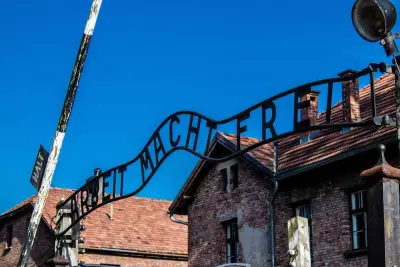
AUSCHWITZ CONCENTRATION CAMP – HISTORY OF THE HOLOCAUST
About Auschwitz Concentration Camp
Auschwitz concentration camp was created in 1940 in Poland, which was under Nazi occupation at the time. It became the most prominent and notorious Nazi concentration camp during the Holocaust. The camp had three main sections: Auschwitz I, the original concentration camp; the larger Auschwitz II Birkenau, built in 1941; and Auschwitz III Monowitz, a forced labor camp supporting nearby industrial factories. Over a million people, mostly Jews, perished there between 1940 and 1945. Today, Auschwitz stands as a memorial to the victims of genocide, preserving their memory and reminding future generations of the Holocaust’s horrors.

Center of Holocaust
Auschwitz became a central symbol of the Holocaust as the largest and deadliest Nazi concentration and extermination camp. Initially, it functioned as a concentration camp for Polish political prisoners, but as the war continued, it expanded and became the Nazis’ primary site for carrying out the Holocaust operations. Its focus shifted to the mass extermination of Jews as part of the Nazis’ “Final Solution.” Auschwitz II-Birkenau, constructed in 1941, became the epicenter of these atrocities, making Auschwitz a lasting symbol of the Holocaust’s horrors.

Over 1 million victims
The majority of Auschwitz victims from 1941 until January 1945 were Jewish men, women, and children. However, other groups were also targeted. Romani people (Gypsies) were deported to Auschwitz, along with Polish prisoners, members of the Polish resistance, intellectuals, and clergy. Soviet prisoners of war were also sent to the camp, as well as other groups like Jehovah’s Witnesses, homosexuals, people with disabilities, and political dissidents who did not support the Nazi Germany regime.

Methods of extermination
Auschwitz II-Birkenau was primarily designed for mass extermination. Upon arrival at Auschwitz, many prisoners were immediately sent to gas chambers under the pretense of going for a “shower”, where Zyklon B gas was released. The bodies were later cremated in nearby facilities.
Medical Experiments: Nazi doctors, especially Josef Mengele, conducted brutal experiments on children, twins, and pregnant women, injecting chemicals, attempting to change eye color, and testing sterilization techniques as part of their pursuit of a “superior race.”
Forced Labor: Prisoners were also forced into physical labor under harsh conditions, receiving little food and rest. Many worked on the production of synthetic rubber and fuel for the Nazi war efforts in the IG Farben industrial complex at Auschwitz.
Starvation: Rations were minimal, leading to severe widespread malnutrition and starvation.
Life in Auschwitz
Life in Auschwitz was filled with fear, cruelty, and terrible conditions. Prisoners lost their names, were tattooed with numbers, and wore colored triangles indicating their group. They lived in overcrowded barracks, facing frequent beatings and public executions. The sick, elderly, and weak were sent to the gas chambers, while the young and healthy were forced to labor. Prisoners slept on wooden boards in barracks surrounded by barbed wire and began each day with hours-long roll calls in freezing cold. They worked long hours in quarries or factories, receiving less than 700 calories a day, and lived in filthy, disease-ridden conditions. Many died from starvation and exhaustion due to forced labor.
Would you like to learn more about the Holocaust, Auschwitz, and its tragic history?

Skip-the-line
Auschwitz Tickets
Skip the lines and explore the remains of Nazi’s largest concentration camp in Poland. Learn about the Holocaust and visit the original barracks and the gas chambers. See the personal belongings of prisoners and harrowing Block 11, known as the Death Block, which holds exhibits about punishments and executions. Walk through the powerful and haunting sight of Auschwitz’s iconic main gate, where so many entered but never left.

Skip-the-Line
Auschwitz Guided Tour
Visit Auschwitz Concentration Camp with a licensed guide and learn about its important and tragic history. Skip the line and enter through the "Arbeit Macht Frei" gate and explore both Auschwitz I and Auschwitz II-Birkenau. Hear about the Holocaust, World War II, and the terrible events that took place there. See the Auschwitz Museum and the remains of gas chambers and crematoria, preserved as a reminder of the horrific crimes that happened there.

Prisoner revolt
In October 1944, Jewish prisoners at Auschwitz started an uprising and managed to destroy Crematorium IV using smuggled gunpowder, but the revolt was soon crushed, and those involved were executed. Despite this, deportations and selections continued while the Nazis began destroying evidence of their crimes as the Allies advanced.

Liberation of Auschwitz
On January 27, 1945, the Soviet Red Army liberated Auschwitz, finding about 7,000 surviving prisoners, many seriously ill. The Nazis had tried to destroy evidence by demolishing parts of the camp and forcing prisoners on death marches to other camps when Soviet forces approached.
Museum and Memorial
After the war, Auschwitz was preserved as both a memorial and museum to honor the victims and ensure that the horrors of the Holocaust would not be forgotten. Established in 1947 at the site of the former Auschwitz-Birkenau concentration camp in Oświęcim, the Auschwitz Memorial houses extensive archives and artifacts belonging to the victims. By preserving original structures such as barracks, gas chambers, and crematoria, it educates millions of visitors each year about the atrocities of World War II. The memorial also hosts important events, including International Holocaust Remembrance Day on January 27, commemorating the camp’s 1945 liberation.
Explore Auschwitz with our guided tours from multiple destinations!

Skip-the-line
Auschwitz Tour from Krakow
Visit the historic grounds of the former concentration camp where over 1 million people, primarily Jews, lost their lives during the Holocaust. Explore the gas chambers, view the original belongings of Auschwitz prisoners, and walk through the historic buildings and barracks as your expert guide shares their stories. Enjoy the convenience of skip-the-line tickets, hotel pick-up, comfortable transportation, and drop-off in Krakow.

Fast-track access
Auschwitz Tour from Warsaw
Join us on a guided tour from Warsaw to Auschwitz, and explore the historic site where over 1 million people lost their lives between 1941 and 1945. This guided tour offers a deep insight into the tragic events of World War II. Experience the somber atmosphere as you visit the gas chambers and original barracks. Your knowledgeable guide will share powerful stories and insights about this tragic chapter in history. The tour includes convenient round-trip transportation from Warsaw.